Around the world, governments are racing to meet the global goal of protecting 30% of the ocean by 2030. But here’s the question:
What makes a Marine Protected Area actually work?
Too often, protected areas exist only on paper. They have boundaries, regulations and legal status, but they aren’t effectively managed, enforced, funded, or involving local communities. Conservationists call these “paper parks”. After years of hearing people say at conferences “we need more protected areas” and “we need more effective conservation”, we wanted to answer a simple question: HOW do we actually make Marine Protected Areas effective?
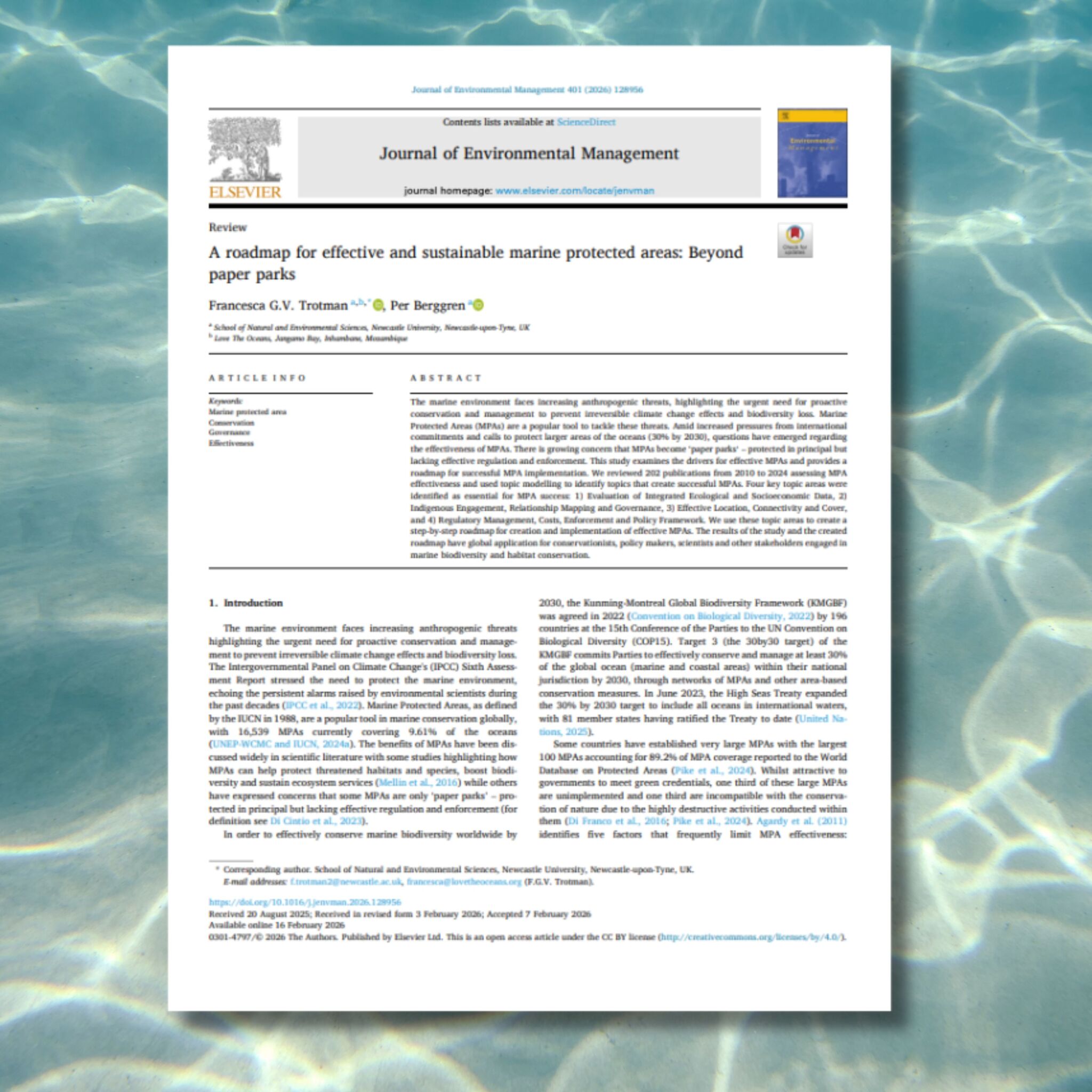
So we reviewed over a decade of scientific research and published a peer-reviewed paper creating a step-by-step roadmap for MPA management. The paper also brings together a suite of freely available tools and resources that practitioners can use at each stage, helping bridge the gap between research and implementation. Our findings showed that successful MPAs need four key stages:
📊 Stage 1: Understanding the ecosystem
Collect ecological data and integrate local knowledge to understand what needs protecting and why.
🤝 Stage 2: Understanding the people
Work with communities, identify conflicts, strengthen local capacity, and establish effective governance.
🗺️ Stage 3: Designing the MPA
Use the information gathered to determine the best location, boundaries, connectivity and zoning.
⚖️ Stage 4: Making it work
Ensure enforcement, secure funding, monitor outcomes, adapt when needed, and only then formally establish the MPA.
One of the strongest messages from the research is that an MPA is only as effective as its management. Legal designation alone is not enough. Without community engagement, governance, enforcement, funding and monitoring, even well-intentioned protected areas can become “paper parks” that exist on maps but fail to achieve meaningful conservation outcomes.
Protecting more ocean is important, but protecting it effectively is what creates real change for marine life, fisheries, and coastal communities.
Read the full paper here: https://www.sciencedirect.com/science/article/pii/S0301479726004160?via%3Dihub